 |
| The happily engaged couple |
Wednesday, 5 February 2014
A new year and a new role
Whilst this blog has enjoyed a brief hiatus as I enjoyed summer- reflecting and recharging (and celebrating my engagement party!) it is back to business. This year I have a new role at school, in the position of curriculum leader for year 11. This position works hand in hand with the Year 11 Coordinator, and together we manage the pastoral and academic needs of our year 11 students.
I am looking forward to sharing stories with you from my experiences in this new role - it has been a week today and what I have to report is that I obviously had more free time than I appreciated as a classroom teacher - it is meeting after meeting!

Non-negotiables
At the end of last year during a whole staff briefing, we were presented with a list of 'non
negotiables' or directives around planning for teaching and learning. All units developed at St
Joseph's College for the 2014 year need to adopt these characteristics.This pedagogical model
has been developed by an action research team at our school, known as the learning
landscapes committee. As we are now one week into teaching, it is a good time to reflect on
whether we have started to properly realise what the learning landscapes committee was trying
to achieve.
I had the opportunity to sit in on a professional learning team (PLT) team meeting this
morning, for a subject that I will no longer be teaching, but am still involved with for an
action research project I am carrying out. We discussed how we are hoping for the unit to
progress, and talked about the ways in which the students would learn the physics concepts
and ideas we wanted them to, and how the subject would be contextualised (in this case,
through design of an energy efficient eco-house, as a term long project). As we discussed the
logistics and the curriculum demands, I was pleased to see that most of the non-negotiables
were raised without specific reference to them.
It appears that we are taking them on board!Does your school have non-negotiables or
some sort of preferred pedagogical model?
NON-NEGOTIABLES
These non-negotiables are unit characteristics that support the realization of the learning goals
outlined in the Melbourne Declaration on Educational Goals for Young Australians (2008) and
those identified by the staff of St Josephs College. These characteristics will form the basis
from which a preferred pedagogical model for St Josephs will be established, and include:
1. Units must cater for a continuum of learning tasks employing shallow to deep thinking
2. Units must cater for differentiation of student ability, differentiating in:
a. product, and/ or
b. process, and/ or
c. tasks, and/ or
3. Units must incorporate ongoing, timely feedback from the teacher (assessment for learning) to the students; from the student to the teacher (assessment of learning)
4. Units must be have structure; a beginning, middle and an end
5. Units must incorporate an significant element of direct instruction
6. Units must incorporate a significant element of student directed learning (inquiry/ investigation/ project etc.)
7. Units must incorporate applications of appropriate technologies
negotiables' or directives around planning for teaching and learning. All units developed at St
Joseph's College for the 2014 year need to adopt these characteristics.This pedagogical model
has been developed by an action research team at our school, known as the learning
landscapes committee. As we are now one week into teaching, it is a good time to reflect on
whether we have started to properly realise what the learning landscapes committee was trying
to achieve.
I had the opportunity to sit in on a professional learning team (PLT) team meeting this
morning, for a subject that I will no longer be teaching, but am still involved with for an
action research project I am carrying out. We discussed how we are hoping for the unit to
progress, and talked about the ways in which the students would learn the physics concepts
and ideas we wanted them to, and how the subject would be contextualised (in this case,
through design of an energy efficient eco-house, as a term long project). As we discussed the
logistics and the curriculum demands, I was pleased to see that most of the non-negotiables
were raised without specific reference to them.
It appears that we are taking them on board!Does your school have non-negotiables or
some sort of preferred pedagogical model?
NON-NEGOTIABLES
These non-negotiables are unit characteristics that support the realization of the learning goals
outlined in the Melbourne Declaration on Educational Goals for Young Australians (2008) and
those identified by the staff of St Josephs College. These characteristics will form the basis
from which a preferred pedagogical model for St Josephs will be established, and include:
1. Units must cater for a continuum of learning tasks employing shallow to deep thinking
2. Units must cater for differentiation of student ability, differentiating in:
a. product, and/ or
b. process, and/ or
c. tasks, and/ or
3. Units must incorporate ongoing, timely feedback from the teacher (assessment for learning) to the students; from the student to the teacher (assessment of learning)
4. Units must be have structure; a beginning, middle and an end
5. Units must incorporate an significant element of direct instruction
6. Units must incorporate a significant element of student directed learning (inquiry/ investigation/ project etc.)
7. Units must incorporate applications of appropriate technologies
Action Research - watch this space
I am currently conducting action research to evaluate whether contextualized science subjects have a place within our schools curriculum. Last year, I was part of a team running a contextualised subject as a pilot to the subject I was intending to run this year, in order to continue the action research project.
Whilst I am no longer teaching that subject, I will still be involved with year eight science, and the physics component of this course, in order to finish my action research. I am seeking to make the teaching and learning of science congruent with the practice of scientific inquiry in local and global communities. This is within the bigger goal of developing an effective science program at St Joseph’s College through authentic and relevant project based learning. This research is supported by a grant from the Catholic Education Office Melbourne (CEOM).
I look forward to sharing updates with you via this blog!
Whilst I am no longer teaching that subject, I will still be involved with year eight science, and the physics component of this course, in order to finish my action research. I am seeking to make the teaching and learning of science congruent with the practice of scientific inquiry in local and global communities. This is within the bigger goal of developing an effective science program at St Joseph’s College through authentic and relevant project based learning. This research is supported by a grant from the Catholic Education Office Melbourne (CEOM).
I look forward to sharing updates with you via this blog!
Friday, 20 December 2013
Final Course Reflection (web2.0 online course)
In this final module, we are asked to consider all the Web 2.0 tools we have learned about during this online course. We are to think of them in the context of Bloom's revised digital taxonomy as well as our own diocese contemporary learning model, in terms of pedagogy, curriculum planning, student learning and educational leadership.
I have found this course to be quite involved, requiring a deeper level of thinking about the potential uses for various web2.0 tools in education. I feel that my appreciation for the use of some of these tools has grown (say using Picasa to curate events, or wikis/GoogleSites to collaborate), whilst for others it has diminished (I see minimal effective use of Facebook or Twitter in the classroom, despite Twitter being useful in maintaining a PLN).
If I consider the iLE@RN model:
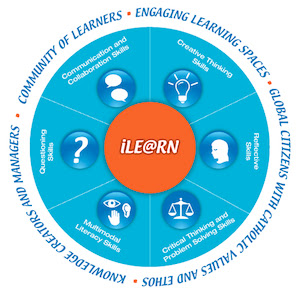
It shows a continuum that is focused on collaboration, creative thinking, reflection, critical-thinking, mathematical and literacy and questioning skills. It sees learners as knowledge creators and managers, who thrive in creative learning spaces. I feel that this constructivist approach where students are involved in the knowledge creation process, will allow for a deeper level of learning than some traditional methods will. Where students are involved in the teaching/learning process in this way, there is a deeper level of commitment/buy in to the process.
Through the use of web2.0 tools, students are able to become involved in this fashion with the learning process. They are able to design and manipulate knowledge and ways of knowing and thus have more ownership over their own learning.
I remember watching an academic at the John Monash Science School observing students conducting experiments during one of my placement's as a pre-service teacher. He was struck by how involved in the process they were, intently focused on what they were doing. This contrasted with how students often perceive the science laboratory. I mentioned simply that the students had ownership over the experiments, as they had designed and chosen them. This begins in the web2.0 classroom as well - and I have witnessed it during this term at my school when my classes were writing to their blogs and had a deep level of focus.
I think this can be developed further through collaboration between classes at a school, or between different schools. Educators need to become more au fait with web2.0 tools and use the strengths of such options - creativity and collaboration and critical-thinking. Web2.0 tools cover the whole gamut of Bloom's Digital Taxonomy, from creating as the highest-order skills, down to remembering. When I reflect on how my students benefited from their blogging experience, in some cases it was the lower-level remembering and understanding, and in other cases it was being able to create content and knowledge and evaluate others' understanding. I would like to further develop how I teach using this, to focus on developing student's ability to critique and question.

Our school is beginning to become more familiar with different web2.0 tools and their use in the classroom, and I think that is an area where we needed to continue to focus, to develop clear goalposts in terms of what we are trying to achieve. Having a student blog for the sake of having a blog might not achieve our educational aims; yet knowing that we can develop student interest and engagement through one, and use it to develop skills of evaluation and collaboration through one might. Being clear about how this is built into the curriculum is also important, as it becomes part of the regular planning/teaching/evaluating process. I would like to think I can help lead my school into effective use of some of these tools as part of our pedagogical model (we have recently develop new non-negotiables in terms of teaching - more to follow!) in the upcoming year, as part of my new role as Curriculum Leader.
I have found this course to be quite involved, requiring a deeper level of thinking about the potential uses for various web2.0 tools in education. I feel that my appreciation for the use of some of these tools has grown (say using Picasa to curate events, or wikis/GoogleSites to collaborate), whilst for others it has diminished (I see minimal effective use of Facebook or Twitter in the classroom, despite Twitter being useful in maintaining a PLN).
If I consider the iLE@RN model:
It shows a continuum that is focused on collaboration, creative thinking, reflection, critical-thinking, mathematical and literacy and questioning skills. It sees learners as knowledge creators and managers, who thrive in creative learning spaces. I feel that this constructivist approach where students are involved in the knowledge creation process, will allow for a deeper level of learning than some traditional methods will. Where students are involved in the teaching/learning process in this way, there is a deeper level of commitment/buy in to the process.
Through the use of web2.0 tools, students are able to become involved in this fashion with the learning process. They are able to design and manipulate knowledge and ways of knowing and thus have more ownership over their own learning.
I remember watching an academic at the John Monash Science School observing students conducting experiments during one of my placement's as a pre-service teacher. He was struck by how involved in the process they were, intently focused on what they were doing. This contrasted with how students often perceive the science laboratory. I mentioned simply that the students had ownership over the experiments, as they had designed and chosen them. This begins in the web2.0 classroom as well - and I have witnessed it during this term at my school when my classes were writing to their blogs and had a deep level of focus.
I think this can be developed further through collaboration between classes at a school, or between different schools. Educators need to become more au fait with web2.0 tools and use the strengths of such options - creativity and collaboration and critical-thinking. Web2.0 tools cover the whole gamut of Bloom's Digital Taxonomy, from creating as the highest-order skills, down to remembering. When I reflect on how my students benefited from their blogging experience, in some cases it was the lower-level remembering and understanding, and in other cases it was being able to create content and knowledge and evaluate others' understanding. I would like to further develop how I teach using this, to focus on developing student's ability to critique and question.
Our school is beginning to become more familiar with different web2.0 tools and their use in the classroom, and I think that is an area where we needed to continue to focus, to develop clear goalposts in terms of what we are trying to achieve. Having a student blog for the sake of having a blog might not achieve our educational aims; yet knowing that we can develop student interest and engagement through one, and use it to develop skills of evaluation and collaboration through one might. Being clear about how this is built into the curriculum is also important, as it becomes part of the regular planning/teaching/evaluating process. I would like to think I can help lead my school into effective use of some of these tools as part of our pedagogical model (we have recently develop new non-negotiables in terms of teaching - more to follow!) in the upcoming year, as part of my new role as Curriculum Leader.
Sunday, 1 December 2013
Module 10 (web2.0 online course)
In this module we were required to look at various learning communities and using wikis. I found this topic quite interesting as the use of wikis in education is something that I have been investigating over the last two years. During my graduate diploma of education study I began learning about Wikispaces, an example of a site that hosts wikis. FYI, a wiki is defined as:
a website or database developed collaboratively by a community of users, allowing any user to add and edit content
During that time I developed a wiki with several other pre-service teachers based on a biology unit that we were planning for. At the time I remember feeling that it was a little cumbersome, requiring us to format and re-edit documents to display them correctly and share them through Wikispaces.
Since that time, I have developed more familiarity with both Wikispaces and Google Sites and have found them to offer a number of benefits to my classes. I wanted to use them for my classes for two reasons: firstly as a place to store digital documents for students to readily access, and more importantly, as a place to help students join in a conversation about their learning process, to enable them to see other learning process from their peers, and share feedback and strategies about their learning.
What I have found so far is that Google Sites works more effectively with the students from my school, in comparison with Wikispaces. The difficulties my students found with Wikispaces was that they had to remember another login for another site, and often the school server blocked students from accessing the website. Whilst the first is easily remedied, the second really impacted on the students taking it up. Google Sites on the other hand was more easily taken up by students due to using the same logon details as their school email, which is already required for all their subjects. I also found that the layout presented by Google Sites was more user friendly, and a more simple interface.
As I have used these websites, my awareness of what they can be used for has developed. Initially I thought they would serve to outline the 'course' and subject materials; which is such a small application. Since I have been using them regularly, I have seen their potential in getting students to complete groupwork collaboratively, in a way that I can observe each students contributions. I have also been able to blog to the class discussing why we are studying certain things in class, presenting students with feedback and discussing class survey results. I feel that they can help my students to see that I can meet their needs outside of the classroom.
I feel that I am able to more easily see more of my students achieving/satisfying requirements of a course through their interactions with a wiki. Several of my students have provided feedback, saying that they enjoy using the websites, but would prefer to use them every class or not at all. I think they find it difficult to add another literacy (digital/use of wiki) when they might already be struggling. Some of them would prefer to use a wiki in place of a notebook, recording their class notes etc. Some of the year 10 science research projects really worked heavily on developing their group page, seeing it as part of their overall project assessment.
Overall I think that I will continue to use a form of wikis in my classroom, and expect that my usage of them will develop with my teaching. I look forward to helping students see different ways of learning, through what they share with their peers. I look forward to establishing a sense of collaboration in my students. I look forward to developing their digital literacy as well.
How do you use wikis in your classroom?
a website or database developed collaboratively by a community of users, allowing any user to add and edit content
During that time I developed a wiki with several other pre-service teachers based on a biology unit that we were planning for. At the time I remember feeling that it was a little cumbersome, requiring us to format and re-edit documents to display them correctly and share them through Wikispaces.
Since that time, I have developed more familiarity with both Wikispaces and Google Sites and have found them to offer a number of benefits to my classes. I wanted to use them for my classes for two reasons: firstly as a place to store digital documents for students to readily access, and more importantly, as a place to help students join in a conversation about their learning process, to enable them to see other learning process from their peers, and share feedback and strategies about their learning.
What I have found so far is that Google Sites works more effectively with the students from my school, in comparison with Wikispaces. The difficulties my students found with Wikispaces was that they had to remember another login for another site, and often the school server blocked students from accessing the website. Whilst the first is easily remedied, the second really impacted on the students taking it up. Google Sites on the other hand was more easily taken up by students due to using the same logon details as their school email, which is already required for all their subjects. I also found that the layout presented by Google Sites was more user friendly, and a more simple interface.
As I have used these websites, my awareness of what they can be used for has developed. Initially I thought they would serve to outline the 'course' and subject materials; which is such a small application. Since I have been using them regularly, I have seen their potential in getting students to complete groupwork collaboratively, in a way that I can observe each students contributions. I have also been able to blog to the class discussing why we are studying certain things in class, presenting students with feedback and discussing class survey results. I feel that they can help my students to see that I can meet their needs outside of the classroom.
I feel that I am able to more easily see more of my students achieving/satisfying requirements of a course through their interactions with a wiki. Several of my students have provided feedback, saying that they enjoy using the websites, but would prefer to use them every class or not at all. I think they find it difficult to add another literacy (digital/use of wiki) when they might already be struggling. Some of them would prefer to use a wiki in place of a notebook, recording their class notes etc. Some of the year 10 science research projects really worked heavily on developing their group page, seeing it as part of their overall project assessment.
Overall I think that I will continue to use a form of wikis in my classroom, and expect that my usage of them will develop with my teaching. I look forward to helping students see different ways of learning, through what they share with their peers. I look forward to establishing a sense of collaboration in my students. I look forward to developing their digital literacy as well.
How do you use wikis in your classroom?
Tuesday, 26 November 2013
Self-assessment in education
Over the last few weeks a lot of things have been happening at my school. Year 12s finished their studies with end of year exams; Year 11s have had their final assessments and are beginning Head Start classes for next year; Year 10s have had final assessments; including their research presentations; Year 8s have had camp; I have been teaching Head Start; I have spoken at my first assembly for year 11 in my new role as curriculum leader; and I have begun moving office into the VCE centre.


Oh and reports and finishing marking.
So apart from feeling a little:
I am actually quite excited about teaching my Head Start classes. This week I have started teaching year 11 biology and chemistry. In my chemistry class today, one of the things I was doing was getting my students to self-assess a timeline that they had produced in groups in the previous class. The timeline illustrated development of atomic theory, hopefully showing understanding, content knowledge, and presentation skills (in order of relative importance).
What I found was that students were quite on the mark in terms of assigning 'grades', compared to what I assign. More importantly, the discussions that ensued were particularly revealing. Through a conversation I facilitated, they indicated why and why not they thought particular posters were well done- several students were corrected by peers for praising well-presented work that showed no understanding. They began to auto-correct and critique the work beyond a surface/superficial level. Some students misidentified information (dates/names etc) as understanding, and were able to be corrected by their peers, who explained that the posters did not in fact show the experimental evidence leading to the development of the different models.
I know that Hattie ranks student self-assessment as an important and powerful element of education, yet I do not think I had experienced just how powerful it could be in my classroom. To watch students reflect and change their thinking in front of me was really satisfying. Taking the time to think, to really slow down and look at a piece of work, was something that benefited my chemistry students. I will definitely be employing this more often in my classes, with the intention of developing self-correcting, deeply understanding students.
Monday, 25 November 2013
Module 9 (web2.0 online course)
In this module, we are asked to explore social networking sites including scootle (educators online community, Australia based), Twitter, LinkedIn and Facebook. The module also reviews what social networking is, in case we had forgotten!
There are some interesting social media statistics out there...
I think that social networking might offer some benefits in the classroom, although given that teachers need to maintain a professional boundary with students, social networking tools are of more benefit to a teacher connecting with other teachers. Establishing an online presence can serve to connect teachers to a large professional network that operates 24/7 around the globe. Beginning teachers can seek advice from expert teachers, and there is a sense of not being so alone knowing that many other teachers are blogging about the idiosyncrasies, the particular demands of, and ways to develop teaching.
One of the problems I see in networking and social media sites, is that as 'new media' voices can be echoed and teachers can begin feeling as though everyone feels the same way, even though only a small minority of people are joined to that conversation. This bias is something that needs careful scrutiny - how many teachers at your school are actually connected to Facebook, LinkedIn or Twitter? Probably less than you might think.
Our school has a mix of staff on any of these social networking sites. A majority use Facebook, but not for teaching purposes. Some are on LinkedIn, as a form of online/digital CV, whilst very few are on Twitter.
I find Twitter a great network for teachers, particularly with conversations such as #edchat and #tmmelb being some useful ones close to home that I follow. The ability to have these ongoing conversations with other education professionals is something that I have found beneficial as a beginning teacher. I also particularly enjoy being able to find teachers' blogs and reading about their experiences and opinions.
Overall I think the benefit of social media in the classroom, at this stage, belongs to empowered teachers being able to connect and share ideas, support and stories.
There are some interesting social media statistics out there...
I think that social networking might offer some benefits in the classroom, although given that teachers need to maintain a professional boundary with students, social networking tools are of more benefit to a teacher connecting with other teachers. Establishing an online presence can serve to connect teachers to a large professional network that operates 24/7 around the globe. Beginning teachers can seek advice from expert teachers, and there is a sense of not being so alone knowing that many other teachers are blogging about the idiosyncrasies, the particular demands of, and ways to develop teaching.
One of the problems I see in networking and social media sites, is that as 'new media' voices can be echoed and teachers can begin feeling as though everyone feels the same way, even though only a small minority of people are joined to that conversation. This bias is something that needs careful scrutiny - how many teachers at your school are actually connected to Facebook, LinkedIn or Twitter? Probably less than you might think.
Our school has a mix of staff on any of these social networking sites. A majority use Facebook, but not for teaching purposes. Some are on LinkedIn, as a form of online/digital CV, whilst very few are on Twitter.
I find Twitter a great network for teachers, particularly with conversations such as #edchat and #tmmelb being some useful ones close to home that I follow. The ability to have these ongoing conversations with other education professionals is something that I have found beneficial as a beginning teacher. I also particularly enjoy being able to find teachers' blogs and reading about their experiences and opinions.
Overall I think the benefit of social media in the classroom, at this stage, belongs to empowered teachers being able to connect and share ideas, support and stories.
Subscribe to:
Posts (Atom)