I had a class earlier this week that made me feel like I was a poor teacher.
It was a class where the intended learning outcome changed during the class.
It was a class where I was irritated and distracted by other things happening at school, and not focused on the class at hand, not present.
It was a class where I was snappy and authoritarian and nothing like the teacher I wanted to be.
It was also a class where I got to go back in and try again. I have a split double over recess, a period before and one after. My feelings of being out of touch with the class, having them frustrated, me disappointed and annoyed got put on pause at recess. I knew I had to re-group.
I went and had a break during recess, had some food, and then went back to the classroom early to prepare. Once the bell went and class began, I immediately took the students out of the classroom. We went to sit outside near the stadium and debrief the morning's class.
I sat them down and waited a minute as they gathered around. I spoke gently about why I had brought them out of class: namely that I was frustrated with how I had run the morning's class. I talked about how I was frustrated that this would for some of them, their last experience of formal science education. I talked about how I felt that my teaching in that class did not help them learn. I talked about how I felt unprepared for this class. I talked about how I felt that in not seeing them earlier in the week (a relief teacher had taken them for their introduction to new topic area) that their behaviour had changed. I asked if any of them had any questions or observations, and whether they felt that my analysis agreed with their own. I kept it relatively brief.
We headed back inside and resumed class. I felt clear on the intended learning outcome for my students, and made sure they knew what it was. Their behaviour was transformed. They were focused and attentive and self-regulating. I was relaxed, and able to teach for learning.
I had just witnessed the power of humility.
Showing posts with label reflection. Show all posts
Monday, 27 October 2014
Friday, 26 September 2014
Do you have the HOTS for science? Part 2
So what are higher order thinking skills?
Defining higher order thinking skills in the context of science education was a relatively tricky. Whilst much of the literature refers to higher order skills, it is not always clearly defined. We know from Bloom's taxonomy that more complex thinking skills include: evaluation, synthesis and creation or in the revised taxonomy: creating, evaluating, analysing. Yet what do these mean necessarily, in the science classroom? What do they look like? If we are to assess them, what is the standard against which we are assessing?
Key Higher Order Thinking Skills
With these questions in mind, I went through the relevant curricula for my state, for the VCE (Victoria Certificate of Education) and pulled out the key skills they focused on, for the areas of physics, chemistry, biology and psychology.
These are the terms I collected (I have highlighted key terms):
Psychology
analyse and interpret data, and draw conclusions consistent with the research question
evaluate the validity
and reliability of research investigations including potential confounding
variables and sources of error and
bias
apply understandings to both familiar and new contexts
evaluate the validity and reliability of psychology-related
information and opinions presented in the public domain
Biology
evaluate experimental procedures and reliability of data
collect, process and record information systematically; analyse and synthesise data; draw conclusions consistent with the
question under investigation and the evidence obtained
apply understandings to familiar and new contexts; make connections between concepts; solve problems
analyse and evaluate the reliability of information and
opinions presented in the public domain
Physics
collecting,
processing, recording, analysing, synthesising and evaluating qualitative and
quantitative data
draw conclusions
consistent with the question under investigation and the information collected,
identifying errors and evaluating
investigative procedures and reliability
and accuracy of data
select first-hand and second-hand data and evidence to demonstrate how physics concepts, theories and
models have developed and been modified over time
Chemistry
draw conclusions
consistent with the question under investigation and the information collected;
evaluate procedures and reliability
of data
identify and address possible sources of uncertainty
make connections between concepts; process information;
apply understandings to familiar and new
contexts
use first and second-hand data and evidence to demonstrate how chemical concepts and theories
have developed and been modified over time
An emerging picture
The common theme that emerges from these curricula is that students need to be taught the higher order thinking skills of analysing and interpreting scientific information to draw logical, valid conclusions; synthesising and processing data in a sensical way; and applying understanding to both familiar and new contexts.
What has become apparent to me over the course of this change project, is that it is not necessarily clear to teachers how they are to set about teaching and assessing such skills in their students. We do not have a coherent, regular process to incorporate the formal teaching of these skills to students. Part of this, in my opinion, stems from teachers not having these skills clearly defined. That is now a major focus of this project, to enable teaching and learning. The conversations with my peers about these skills have been useful professional development. Just by reflecting on how we teach and assess higher order thinking, we are starting to make our actions align with our intentions.
That we do not have a formal plan for teaching these skills reminds me of this blog post by Grant Wiggins, author of Understanding by Design (UbD). He refers to inferencing, a higher order skill, of drawing reasoned conclusions from evidence, with a quote that suggests that it cannot be taught, when of course it can. This is a particular skill that needs to be taught in the science classroom. The other skills mentioned above also need to be taught.
I have attached a table below - that begins to define what these higher order skills are, and how they can be taught and assessed. Let me know what you think!
HOTS
|
Explanation
|
Teaching activities
|
Assessment
|
Analysing and
interpreting information
|
Students being exposed to quantitative data and being
asked to draw conclusions
Students being exposed to qualitative data and being asked
to draw conclusions
Students drawing valid, logical, reasoned conclusions
|
Students regular handling data; from practice questions
and from experiments
Students being asked to observe patterns or trends in
quantitative data
Students practicing drawing rational conclusions
Students being provided with explicit examples of
illogical and irrational conclusions and having these explained
|
Test questions that provide scenarios for students to
interpret
Students being given experimental results where errors
have been made during the experiment and they have to interpret the effect on
the outcome
Students being asked about a range of possible conclusions
drawn about an experiment and needing to describe them as valid/invalid and
provide a rational explanation
|
Friday, 11 April 2014
What is the best class you have taught this year?
Leading into the Easter holidays I get the chance to engage in one of the most effective Professional Development practices available. I get the chance to reflect on my own practices, and am held accountable for each class that I teach. Oh and I get paid to do it to.
I get to mentor a student teacher for their block placement/practicum for a week leading into the holidays, and then four weeks proceeding the holidays. When I sat down with my student teacher to negotiate what she wanted to learn from her placement, and what her expectations were, I went through mine as well. I see the chance to have an adult set of eyes in the classroom, with a mind freshly full of educational theory watching and critiquing my every teaching move, to be a little challenging, but mostly as a great chance for me to actively reflect on my practice in the moment of doing so.
I think too often teachers are able to rationalise their teaching practices, as they are often assessed/assess themselves outside of the classroom. They can put lots of effort into the planning process, design 'great' units, and convince themselves that they have done an effective job. I am guilty of this. Actually critiquing your teaching in real time is much harder. I find that having a student teacher makes me slow down the process of teaching, as I am conscious of what I am demonstrating to them. I want to be able to justify and explain what I have done in the classroom, and just their presence makes me delve deeper into my planning/teaching/reflection process.
What I noticed from the last week of teaching in term 1 and having a student teacher in the classroom, was that I was tired from the long term. My students were tired. My staff were tired. Some of my approaches to classes were less than enthusiastic, particularly when juxtaposed with my overly motivated student teacher. Facing some technical difficulties tested my resilience. For several classes I remember feeling like a beginning teacher, making mistakes as I was being watched. It was difficult. I felt as though even the change in the classroom dynamics was difficult- my classroom management was being tested, and I wasn't responding as well as I could have been. I was struggling.
I also remember having a particular year 12 chemistry class that worked well; students receiving feedback regarding a SAC, and then covering brand new content on spectroscopy and being able to integrate this into a grid that compares/contrasts the different spectroscopic techniques they need to learn. I came out of that class feeling vibrant and able. It wasn't the best class I have taught, but it was an effective lesson in achieving what it intended. I felt like I knew my content, and knew a way to chunk it down effectively for my learners. I felt like they were involved in the class, asking questions, and wanted to learn. My goal is to create more classes that achieve this.
My question is: what is the best class you have taught this year? And why?
Friday, 20 December 2013
Final Course Reflection (web2.0 online course)
In this final module, we are asked to consider all the Web 2.0 tools we have learned about during this online course. We are to think of them in the context of Bloom's revised digital taxonomy as well as our own diocese contemporary learning model, in terms of pedagogy, curriculum planning, student learning and educational leadership.
I have found this course to be quite involved, requiring a deeper level of thinking about the potential uses for various web2.0 tools in education. I feel that my appreciation for the use of some of these tools has grown (say using Picasa to curate events, or wikis/GoogleSites to collaborate), whilst for others it has diminished (I see minimal effective use of Facebook or Twitter in the classroom, despite Twitter being useful in maintaining a PLN).
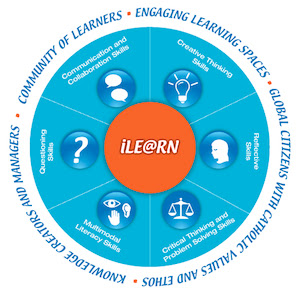
If I consider the iLE@RN model:
It shows a continuum that is focused on collaboration, creative thinking, reflection, critical-thinking, mathematical and literacy and questioning skills. It sees learners as knowledge creators and managers, who thrive in creative learning spaces. I feel that this constructivist approach where students are involved in the knowledge creation process, will allow for a deeper level of learning than some traditional methods will. Where students are involved in the teaching/learning process in this way, there is a deeper level of commitment/buy in to the process.
Through the use of web2.0 tools, students are able to become involved in this fashion with the learning process. They are able to design and manipulate knowledge and ways of knowing and thus have more ownership over their own learning.
I remember watching an academic at the John Monash Science School observing students conducting experiments during one of my placement's as a pre-service teacher. He was struck by how involved in the process they were, intently focused on what they were doing. This contrasted with how students often perceive the science laboratory. I mentioned simply that the students had ownership over the experiments, as they had designed and chosen them. This begins in the web2.0 classroom as well - and I have witnessed it during this term at my school when my classes were writing to their blogs and had a deep level of focus.
I think this can be developed further through collaboration between classes at a school, or between different schools. Educators need to become more au fait with web2.0 tools and use the strengths of such options - creativity and collaboration and critical-thinking. Web2.0 tools cover the whole gamut of Bloom's Digital Taxonomy, from creating as the highest-order skills, down to remembering. When I reflect on how my students benefited from their blogging experience, in some cases it was the lower-level remembering and understanding, and in other cases it was being able to create content and knowledge and evaluate others' understanding. I would like to further develop how I teach using this, to focus on developing student's ability to critique and question.
Our school is beginning to become more familiar with different web2.0 tools and their use in the classroom, and I think that is an area where we needed to continue to focus, to develop clear goalposts in terms of what we are trying to achieve. Having a student blog for the sake of having a blog might not achieve our educational aims; yet knowing that we can develop student interest and engagement through one, and use it to develop skills of evaluation and collaboration through one might. Being clear about how this is built into the curriculum is also important, as it becomes part of the regular planning/teaching/evaluating process. I would like to think I can help lead my school into effective use of some of these tools as part of our pedagogical model (we have recently develop new non-negotiables in terms of teaching - more to follow!) in the upcoming year, as part of my new role as Curriculum Leader.
Subscribe to:
Posts (Atom)